

nº99 / CASTELLO RUSPOLI / ITALY
Updated: Jul 23

In the town of Vignanello, 70 kilometres north of Rome, in Lazio, Castello Ruspoli is a perfect example of Italian Heritage, and the Ruspoli Garden is one of the best-preserved gardens of the Italian Renaissance.
Review by Zoltan Alexander

THE GARDEN
OF
RUSPOLI and Castello Ruspoli, where the Pope slept, and flamboyant parties entertained the guests
Although the Garden of Ruspoli is not a film, nor The Garden of the Finzi-Continis (Il giardino dei Finzi Contini) directed by Vittorio De Sica in 1970, it is a story of a noble family throughout the centuries.
The first traces of the Castello Ruspoli, as a fortress, date back to 847, when it was built on a cliff where it stands today. For a short period of time, the castle was converted into a monastery for the Benedictine monks and became the source of a long-standing dispute between the Church and the Aldobrandini, Orsini, and Borgia families, which continued until the 16th century.
In 1531, Pope Clement VII awarded the town of Vignanello as a fief to Beatrice Farnese, the wife of Antonio Baglioni, a noble of Perugia. Ortensia, their daughter, married Sforza Marescotti, and they became the first count and countess of Vignanello. From then on, the Castle Vignanello was referred to as Castello Marescotti. The name Ruspoli came later from an ancient Florentine family that moved to Siena and was united with the Marescotti family in 1704.
Ortensia Farnese converted the castle into a residence, while she still maintained the original characteristics of the fortification. The estate was designed by architect Sangallo il Giovane, the exterior is credited to Jacopo Barozzi da Vignola.
Fifteen popes were related to the Marescotti-Ruspoli family, as the Ruspoli family had always been an influential Italian noble family with close connections to the Sancta Sedes (Holy See), the preeminent episcopal See of Rome of the Catholic Church and the Vatican City.


PHOTO / Castello Ruspoli / Photo © Courtesy of Tao Ruspoli
The garden, constructed in 1611, is considered one of the most important gardens in Italy. Marcantonio Marescotti, the 3rd Earl of Vignanello and Parrano, was married to Ottavia Orsini, who planned the garden, divided it by four avenues, 12 boxwood sections, containing a six-pointed central fountain.
The garden still stands and is one of the best-preserved examples of the Italian Renaissance, providing a perfect set for many movies and TV series. The exteriors of Villa Santa in The Decameron (1971), directed by Pier Paolo Pasolini, were filmed on location at Castello Ruspoli.


PHOTOS / Castello Ruspoli / Photos © Courtesy of Tao Ruspoli
On the ground floor, next to the family tree, a chapel is dedicated to Sister Giacinta, a member of the Ruspoli family, who was canonised a Saint by Pope Pius VII in 1807. Her habit and self-flagellation tools are displayed in a glass cabinet. Even the wall is emblazoned with “The pope slept here” in Latin, after Benedict XIII’s visit in 1725.
The green salon is the largest in the castle with heavy, rose-patterned, coffered ceilings, the symbol of the Orsini family. The particularity of the room is the door itself, one side of which is entirely covered in leather, matching the motif on the ceiling. These motives, as a signature, are also found in the garden's flowerbeds.
On one of the stone fireplaces, there is a broken heart Coat of Arms that hides a story. Ortensia Farnese, the Countess of Vignanello, known as “Lucrezia Borgia of Parrano”, who married Sforza Marescotti, and due to an episode of jealousy, killed her husband in that very room with a fire poker and scraped off half of the stone heart. Her family ties to the Pope, however, allowed her to avoid punishment, and she received a full pardon for her heinous acts from Pope Paul III Farnese, and another relative, the Grand Cardinal Alessandro Farnese.

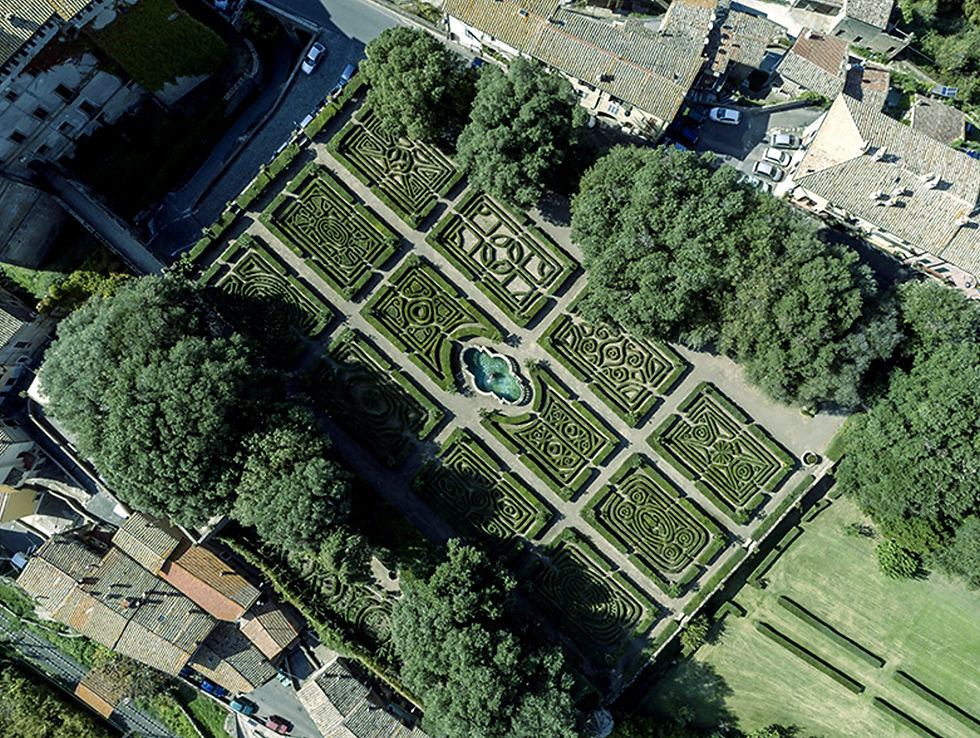
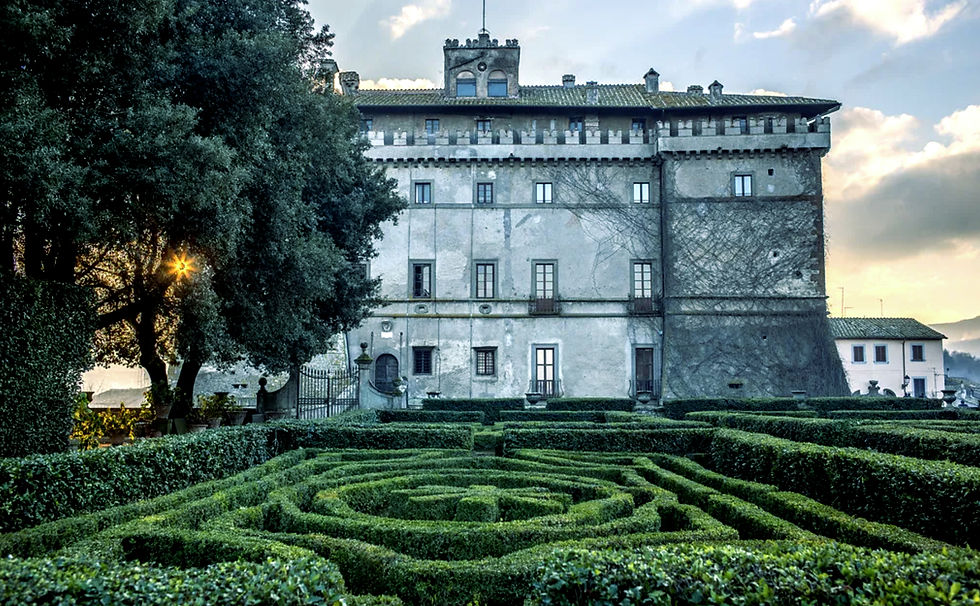
PHOTOS / Castello Ruspoli / Photos © Courtesy of Tao Ruspoli
The main entrance to the castle today is from the Piazza della Repubblica. To enter the garden from the castle, one has to walk through a double-arch stone bridge that used to be above a moat, a water ditch, at the time. Now, the curtain walls and the water under the bridge disappeared, and the ditch became a small street packed with cars.
The Castello itself is lavishly furnished. The chairs are covered with red or green velvet and golden silk, in perfect harmony with the walls. There are many family photographs around of the Ruspoli family, especially of Alessandro Ruspoli (known as "Dado"), the 9th Prince of Cerveteri and 14th Count of Vignanello, a notorious playboy with a black eyepatch, since he had an accident whilst he was hunting. He frequently partied at the castle with Salvador Dalí, Brigitte Bardot and many other stars, and it is said that he was a source of inspiration for Federico Fellini in making La Dolce Vita.


PHOTOS / Interior of Castello Ruspoli / Photos © Courtesy of Tao Ruspoli
Dado, a hopelessly eccentric and charismatic gentleman, has never worked in his life, claiming that he “never had the time.” Of course, the life of an eccentric is rarely lucrative, and Dado had to sell many of the valuables of the castle as needed to maintain his luxurious life.
As time passed, the maintenance proved too much for him, and he handed the castle on to his younger brother, Sforza Ruspoli. During the years, many illustrious guests stayed there, including Pope Benedict XIII, Handel, Pasolini, and Italian actor Ugo Tognazzi.
Serving as a private residence, many generations lived at the castle, which remains the property of the Ruspoli family, with the garden that is well-known for its Renaissance-era Giardino all'italiana.


PHOTOS / Dinner at Castello Ruspoli / Photos © Courtesy of Tao Ruspoli
Today, the heritage of Vignanello continues with the family, Claudia and Giada Ruspoli, the daughters of Dado’s brother Sforza Ruspoli, who manage the castle together.
“My parents were living like hippies,” says Claudia. “My mother was very adventurous. Sleeping bags, cooking, music, and a lot of running naked,” she says, “because they didn’t ever put you in pants!”
“There was an explosion of love and life I had in my youth with Dado”, Claudia recalls. “Having children, planting fruit trees and roses in the gardens, with friends, poets, musicians, and artists of all kinds, bringing it back to life.”


PHOTO / (top) The Ruspoli family / (below) Tao Ruspoli / Photo © Courtesy of Tao Ruspoli
PHOTO / (below) Claudia Ruspoli for Vogue Italia 1971 / Photo © Courtesy of Gianna Turilazzi
Tao, one of Alessandro Ruspoli’s five children, agrees.
Tao dei Principi Ruspoli was born in 1975 in Bangkok (Thailand), and brought up in Rome and Los Angeles, where he currently lives. Tao is an Italian-American filmmaker, photographer, and musician. He is known for his documentary features and for being the founder of the Bombay Beach Biennale and the Bombay Beach Institute.
It was Tao’s mother, actress Debra Berger, who fell in love with the castle and insisted that she and Dado would spend more time there. Today, the family has managed to maintain Castello Ruspoli in Vignanello, the Palazzo Ruspoli in Rome, and the Palazzo Ruspoli in Cerveteri.
“This is the only place where we could still feel the roots of a family,” explains Claudia.
Her sister Giada agrees. “It is very special to live in a building that constantly reminds you of your past, your heritage, and the history that you carry within yourself.”

Castles were built to protect
and to be lived in,
not merely admired or looked at.
INDEX
COVER
Garden of Ruspoli
Photo © Courtesy of Castello Ruspoli
Cover design © ZOLTAN+MEDIA Paris
PLACE
Castello Ruspoli
Vignanello (Italy)
SPECIAL THANKS
Tao Ruspoli
Claudia Ruspoli
Giada Ruspoli
PHOTOGRAPHERS
© Tao Ruspoli
© Castello Ruspoli
VISUALS & WEBDESIGN
© Zoltan Alexander ZOLTAN+MEDIA Paris
WEB LINK